
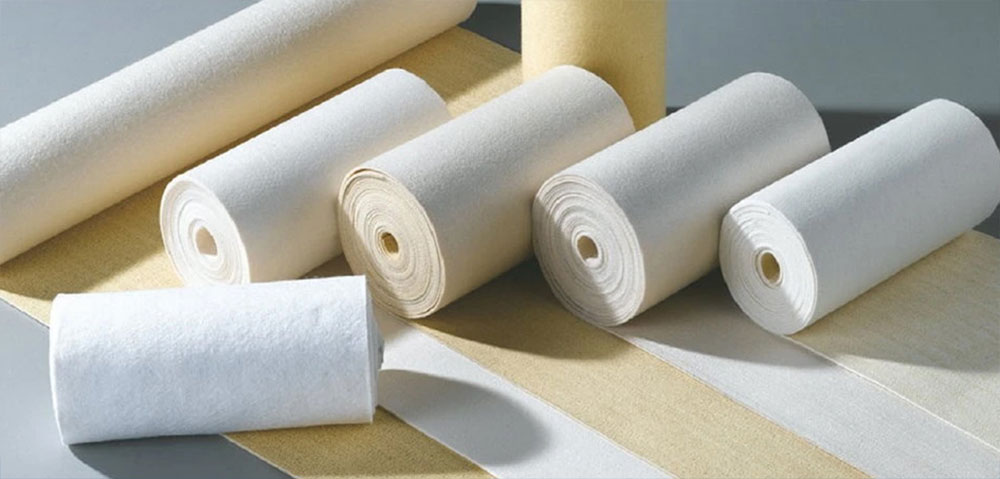
The filter bag is the core component of a baghouse dust collection system. The choice of filter bag material directly determines key performance parameters of the dust collector, including equipment size, dust removal efficiency, emission concentration, operating resistance, service life, and overall system stability.
Therefore, when selecting needle felt, it is essential to comprehensively consider operating conditions such as dust concentration, gas temperature, humidity, and pH value, as well as the physical and chemical characteristics of the dust, including particle size, adhesiveness, and abrasiveness. Only by selecting the appropriate needle felt can the dust collection system operate efficiently, reliably, and economically.
1. Principles for Needle Felt Selection
The selection of needle felt should be based on the properties of the dusty gas, the characteristics of the dust, and the bag cleaning method. In general, the following principles should be followed:
- Reasonable fiber structure with high dust capture efficiency
- Easy dust cake release, good cleaning performance, and low tendency to clog
- Appropriate air permeability with low operating resistance and high filtration accuracy
- Sufficient mechanical strength and excellent dimensional stability
- Good resistance to heat, chemicals, oxidation, and hydrolysis, with broad application adaptability
- Stable and reliable performance with consistent raw material supply
- Cost-effective solution with long service life
2. Selection According to Filter Media Characteristics
2.1 Polyester Needle Felt
Polyester needle felt is commonly used in low-temperature applications. Under normal conditions, it is used without surface coating. However, when emission limits are below 30 mg/Nm³, or when filtering very fine or humid dust, surface treatments or membrane lamination may be considered to improve filtration efficiency and dust release performance.
2.2 PTFE (Polytetrafluoroethylene)
PTFE, also known as Teflon, can be expanded into a highly microporous structure with pore sizes ranging from 0.1 μm to 2.0 μm and a porosity exceeding 80%. It offers outstanding chemical resistance and is virtually unaffected by strong acids, alkalis, and highly corrosive chemicals. PTFE can operate continuously over a wide temperature range from –200°C to 250°C and provides excellent electrical insulation and an extremely smooth surface.
PTFE membranes are often laminated or combined with needle felt substrates through special processing techniques to significantly enhance filtration efficiency, reduce operating resistance, and extend service life.
2.3 Nomex (Aramid) Needle Felt
Nomex needle felt is suitable for high-temperature applications with relatively coarse dust particles. It offers better flexibility and impact resistance than fiberglass and can withstand higher pulse-jet cleaning pressure, allowing more filter bags to be cleaned simultaneously under high-pressure conditions.
2.4 Fiberglass Needle Felt
Fiberglass needle felt exhibits excellent high-temperature resistance, high tensile strength, and good resistance to acids, alkalis, and moisture. However, due to its limited flexural strength, fiberglass filter bags are more prone to mechanical damage during installation and operation and are not suitable for high-intensity pulse cleaning.
With advances in glass fiber processing and surface treatment technologies, including various coating methods, fiberglass needle felt now delivers significantly improved filtration performance and durability. It has been widely adopted in high-temperature filtration applications, especially in Europe and North America.
2.5 P84 (Polyimide) Needle Felt
P84 needle felt is manufactured from high-performance polyimide fibers developed by an Italian company. It offers excellent overall performance and strong resistance to acids and alkalis. Although its maximum temperature resistance is slightly lower than that of fiberglass, its unique fiber cross-section provides high dust capture efficiency. P84 needle felt is typically used without membrane coating, so its filtration efficiency may be lower than that of membrane-laminated filter bags in ultra-low emission applications.
3. Selection Based on Dusty Gas Properties
3.1 Gas Temperature
Gas temperature is one of the most critical factors in needle felt selection. Dusty gas below 130°C is generally classified as ambient-temperature gas, while gas above 130°C is considered high-temperature gas.
Each filter bag material has a long-term continuous operating temperature and a short-term peak temperature. The long-term temperature refers to the maximum temperature the filter bag can withstand during continuous operation. The short-term peak temperature refers to the maximum temperature the bag can tolerate for a short duration, typically no more than 10 minutes per day. Exceeding these limits may cause softening, deformation, or permanent damage to the filter media.
3.2 Gas Humidity
Dusty gas can be categorized based on relative humidity:
- Dry gas: relative humidity ≤ 30%
- Medium humidity gas: relative humidity 30–80%
- High humidity gas: relative humidity ≥ 80%
High humidity, especially in combination with high temperature and SO₂-containing gas, can lead to condensation during cooling. Condensation causes dust adhesion, bag clogging, and corrosion of structural components, requiring special attention during material selection.
For humid gas conditions, the following should be considered:
- Moisture promotes dust adhesion, particularly for hygroscopic or deliquescent dust, leading to bag blinding. Filter bags with smooth surfaces and good water repellency, such as fiberglass or long-fiber materials with surface treatments (silicone oil impregnation, fluorocarbon resin treatment, acrylic coating, or PTFE membrane lamination), are recommended.
- High temperature combined with high humidity accelerates hydrolysis, especially for materials with poor hydrolytic stability such as polyester, nylon, and polyimide.
- The inlet gas temperature should be maintained at least 10–30°C above the dew point to prevent condensation.
3.3 Chemical Composition of Gas
Flue gases and chemical process gases often contain acids, alkalis, oxidizing agents, and organic solvents. These components are frequently influenced by temperature and humidity simultaneously. Therefore, the chemical composition of both dust and gas must be carefully analyzed, with priority given to the dominant corrosive factors when selecting needle felt.
4. Selection Based on Dust Characteristics
4.1 Dust Wettability and Adhesion
Dust wettability is typically characterized by the contact angle. Dust with a contact angle below 60° is considered hydrophilic, while dust with a contact angle above 90° is hydrophobic.
Hygroscopic or deliquescent dust tends to absorb moisture, increasing particle cohesion and adhesion to the filter bag surface. Over time, this leads to dust cake compaction and cleaning failure. Dust containing CaO, CaCl₂, KCl, MgCl₂, or Na₂CO₃ may undergo chemical reactions with moisture, resulting in severe bag blinding.
For such dust, filter bags should have smooth surfaces, minimal fiber fuzz, and strong water repellency. Membrane-laminated or plastic-coated filter media are preferred. For highly adhesive dust, filament pile fabrics should be avoided, and surface treatments such as singeing, calendering, mirror finishing, dipping, or coating should be fully utilized.
4.2 Combustible Dust and Electrostatic Charge
Certain dusts can ignite or explode when suspended in air under specific concentration conditions. Ignition sources typically include friction sparks, static electricity, or hot particles. Synthetic filter materials are prone to static charge accumulation, which increases the risk of sparking.
For combustible or electrostatically sensitive dust such as coal dust, coke dust, aluminum powder, and magnesium powder, flame-retardant and conductive needle felt should be selected. Suitable materials include PVC, PPS, P84, and PTFE fibers with an oxygen index greater than 30.
For fibers with an oxygen index below 30, such as polypropylene, nylon, polyester, and polyimide, conductive fibers should be blended into the filter media. Conductive fibers may be incorporated into the warp or weft, with surface resistance controlled below 10⁹ Ω. Common conductive fibers include stainless steel fibers and modified carbonized synthetic fibers.
4.3 Dust Flowability and Abrasion
High dust velocity and strong friction significantly reduce filter bag service life. Abrasive dust with rough, angular particles causes more wear than smooth, spherical particles. Dust particles around 90 μm produce the most severe abrasion, while wear decreases significantly when particle size falls below 5–10 μm.
Abrasion increases with airflow velocity to the second or third power and is proportional to particle size to the power of 1.5. Therefore, airflow velocity and distribution must be strictly controlled.
For abrasive dust such as aluminum powder, silicon powder, coke dust, carbon black, and sintered ore dust, filter bags with high abrasion resistance should be selected. Wear typically occurs at the lower section of the filter bag. Key considerations include:
- Chemical fibers generally offer better abrasion resistance than glass fibers. Fine, short, and crimped fibers perform better than thick, long, and smooth fibers.
- Needle-punched felt with enhanced fiber entanglement improves wear resistance. Satin weaves and brushed surfaces can also enhance abrasion resistance, though they may increase operating resistance.
- Surface treatments such as coating and calendering can further improve abrasion resistance. For fiberglass filter bags, treatments with silicone oil, graphite, or PTFE resin are effective. However, in extremely abrasive conditions, membrane layers may wear prematurely and lose their functional benefits.