
Fly ash is a fine solid particle produced during the combustion of coal in power plants or industrial boilers. It is carried out with the flue gas and collected by a dust collector, resulting in an industrial byproduct. It easily disperses into the air and enters the human respiratory system, causing health problems such as coughing and asthma; it also pollutes the air, water, and soil, and may even pose environmental risks due to its heavy metal content. Therefore, fly ash must be safely collected and treated using specialized dust removal equipment and filter bags.

Common problems with fly ash during dust filter operation
- Easy to Accumulate
In the absence of air circulation, fly ash settles rapidly and forms a dense layer.
- High Dust Concentration
In enclosed or poorly ventilated spaces, fly ash easily becomes suspended, creating a high-dust environment.
- Easy to Agglomerate and Harden
Under varying humidity or temperature conditions, fly ash easily absorbs moisture and agglomerates, affecting handling and transport.
- Heavy Metal Retention
Heavy metals in fly ash tend to accumulate locally and are difficult to disperse.
- Increased Dust Explosion Risk
The dust concentration of fly ash can reach explosive levels upon contact with a spark.
- Enhanced Corrosivity
Fly ash reacts with water and sulfur dioxide/sulfates to form acidic substances, accelerating equipment corrosion.
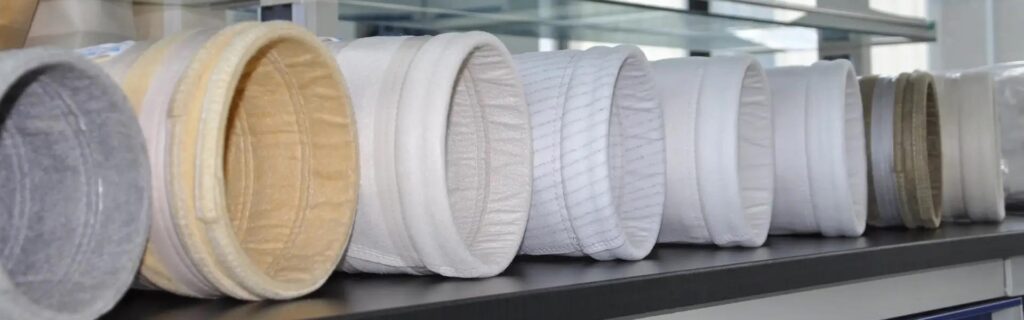
Common fly ash filtration media materials
To cope with the abrasive and high-temperature characteristics of fly ash, the following filter media are widely used:
| Material Type | Continuous Temperature Resistance | Key Features |
| PPS (Polyphenylene Sulfide) Needle Felt | Approx. 190°C | Excellent chemical resistance and high-temperature stability; suitable for sulfur-containing and humid conditions |
| P84 (Polyimide) Needle Felt | Approx. 240°C | Very high filtration efficiency and low emissions; Y-shaped fibers capture fine dust effectively |
| Nomex (Aramid) Needle Felt | Approx. 200°C | Good high-temperature tolerance with strong abrasion resistance |
| Fiberglass Filter Needle Felt (optional PTFE membrane) | Up to 260°C | Outstanding high-temperature resistance; ideal for harsh and demanding environments; PTFE membrane enables ultra-low emissions |
| PTFE (Teflon) Needle Felt | 260°C+ | Premium solution for extremely corrosive or very high-temperature conditions; best chemical resistance |
Common Size
| Filter bag type | Diameter(mm) | Length(mm) |
| Round or pleated | 120 or customized | 2000 2400 2800 3200 3600 4000 4400 4800 5200 5600 6000 7000 |
Pulse injection fly ash collection working principle
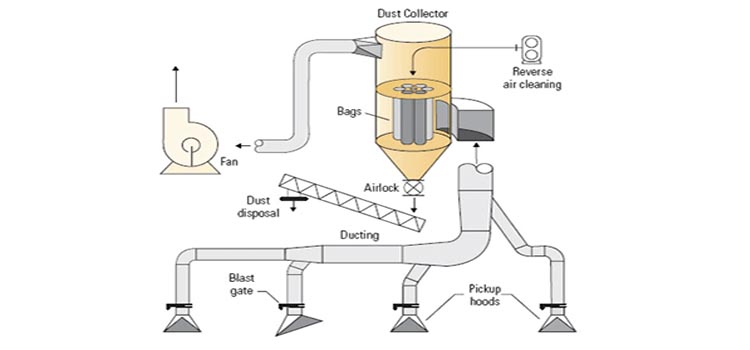
When dusty gas enters the baghouse through the air-induction system, the airflow velocity decreases, causing heavier dust particles to settle directly into the hopper, while lighter particles are carried upward to the surface of the filter bags. The filter bags are typically made of needle-felt media, capable of achieving filtration accuracy of less than 1 μm. As dust accumulates on the surface, it forms a dust cake that purifies the gas as it passes through the filter material.
Over time, as more dust builds up, the resistance (pressure drop) across the filter bags increases. To maintain stable operation, once the resistance reaches the preset threshold, the electronic pulse controller activates the cleaning cycle. It sequentially opens each pulse valve, releasing compressed air from the air tank through the blowpipe into the corresponding filter bags.
The sudden pulse of compressed air causes the filter bags to expand momentarily, shaking off the dust cake from their surface and restoring their original air-permeability. The dislodged dust falls into the hopper and is discharged through the ash removal system, completing the entire cleaning and filtration process.