
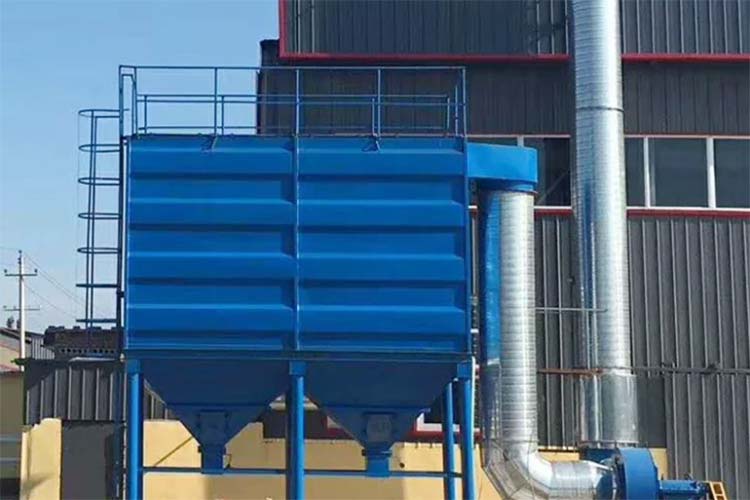
The baghouse dust collector (also known as a fabric filter dust collector) is one of the most widely used air purification systems in industrial environments.
It plays a crucial role in capturing dust and particulate matter generated during production, helping to maintain clean working conditions and ensuring compliance with environmental emission standards.
Working Principle
The baghouse dust collector operates based on the filtration separation principle.
Dust-laden air enters the unit through the inlet and first passes through a pre-separation chamber, where large and heavy particles are removed by inertia or centrifugal force.
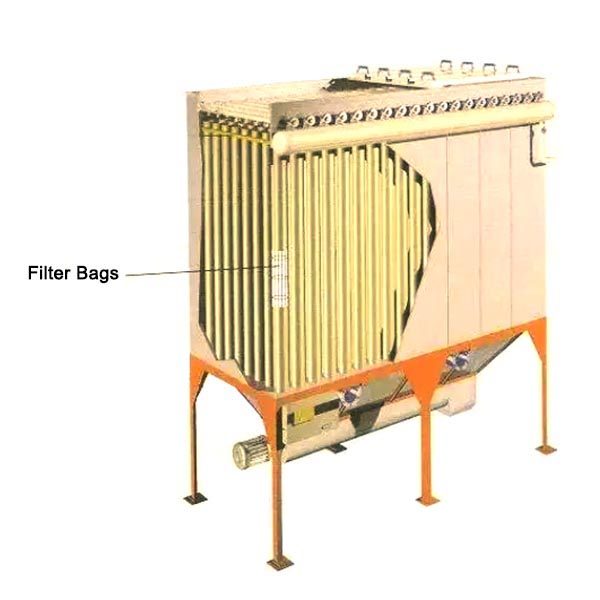
Then, the gas flows into the filter chamber. As the air passes through the filter bags, fine dust particles are trapped on the outer surface of the filter media, while clean air passes through and exits via the outlet.
Over time, dust accumulates on the filter bags, increasing the resistance of the system. When the pressure drop reaches a preset value, the cleaning system activates automatically.
Through methods such as pulse jet cleaning, the compressed air bursts through the filter bags, shaking off the dust cake and restoring the bags’ filtration efficiency for continuous high-performance operation.
Structural Components
(1) Air Inlet
The air inlet is typically located at the top or side of the dust collector.
Its design ensures uniform air distribution and minimizes localized high-velocity zones. The inlet dimensions are precisely calculated according to airflow and dust load, ensuring optimal dust-laden gas entry and efficient subsequent filtration.
(2) Pre-Separation Chamber
The pre-separation chamber is the first stage of dust removal and often includes devices such as cyclone or inertial separators.
Cyclone Separator: Uses centrifugal force to separate heavier dust particles that are thrown toward the chamber wall and fall into the hopper.
Inertial Separator: Relies on the difference in particle inertia when the airflow changes direction, allowing dust particles to separate from the gas stream.
This stage effectively removes most coarse particles, reducing the load on the filter bags and extending their service life.
(3) Filter Chamber
The filter chamber is the core of the dust collector and mainly consists of filter bags, supporting cages, and a cleaning system.
- Filter Bags
The filter bags are made from high-performance materials such as polyester, fiberglass, or aramid (Nomex).
These materials feature excellent filtration efficiency, chemical resistance, and temperature stability.
During operation, a dust layer—often called the primary dust cake—forms on the surface of the bag, enhancing filtration performance together with the internal fiber structure.
- Supporting Cages
Supporting cages maintain the shape and position of the filter bags, preventing collapse or wear caused by air pressure.
They are usually made of carbon steel or stainless steel with sufficient strength and rigidity, allowing full use of the filtration area and simplifying bag replacement.
- Cleaning System
The cleaning system keeps the filter bags in optimal condition.
Common methods include:
1.Pulse Jet Cleaning (most widely used)
2.Mechanical Shaking
3.Reverse Air Cleaning
In the pulse jet system, compressed air is rapidly injected into the bags, causing sudden expansion and vibration that dislodges the dust cake.
This method provides strong cleaning power, minimal bag damage, and stable long-term performance.
(4) Air Outlet
After filtration, purified air is discharged through the outlet.
The outlet design ensures smooth exhaust flow and prevents turbulence or backflow.
Pressure and flow sensors are often installed to monitor system performance and verify that emissions meet environmental standards.
(5) Control System
The control system is the “brain” of the baghouse dust collector, composed of a PLC controller, touch-screen interface, and various sensors.
- PLC Controller
Coordinates all operational components, automatically adjusts cleaning cycles and pulse pressure, and performs fault detection and alarms.
- Touch Screen
Provides an intuitive interface for operators to monitor system status, set parameters, and view historical data.