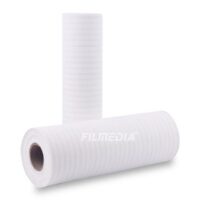
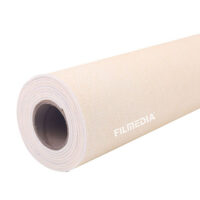
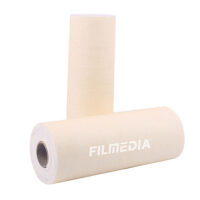
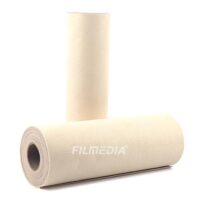
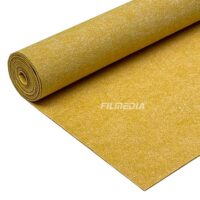
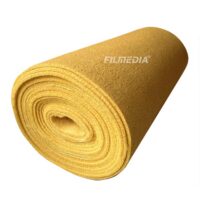
Our flame retardant polyester needle felt is a new type of carbon coated filter material. We use a special surface treatment process to extend its performance and service life.
- Material: polyester staple fiber, carbon powder.
- Scrim: polyester staple yarn.
- Width: ≤2.2m.
- Thickness: 1.7mm.
- Weight: 400-600g/m2 ±10%.
Description
If you need fire-retardant materials for a filtration or dust collection system, fire-retardant polyester needle felt can provide a reliable and cost-effective solution. It is a specialized non-woven fabric designed to resist ignition and slow down the spread of flames. It is commonly used in applications where fire safety is a critical requirement.
- Protection from flying sparks.
- Resistant at high temperatures.
- Long operational life.
- Flame retardant.
- Good acid, alkali and hydrolysis resistance.
- Excellent wear resistance.
- High quality and economical.
Customizable Colors

Advantages Over Other Materials
- More cost-effective than inherently fire-resistant fibers like aramid or modacrylic.
- Easier to process than fiberglass while still providing good fire protection.
- Can be recycled (if untreated with hazardous chemicals).
Physical and Chemical Characteristics of Fire-retardant Polyester Needle Felt
| Product name | Anti-spark polyester needle felt 500g/m² | |
| Product Code | ES-ASPE500C | |
| Physical properties | ||
| Fiber | polyester staple fiber | |
| Scrim | polyester filament yarn | |
| Weight | g/m² | 500 |
| Thickness | mm | 1,8 |
| Width | mm | ≤2,2 |
| Finish treatment | Singeing, Calendering, Heat setting, Carbon Coating | |
| Air permeability | l / m2 / s @200pa | 200 ~ 350 |
| Tensile strength | Warp | 1100 |
| Weft | 1200 | |
| Tensile elongation | Warp | 20 |
| Weft | 30 | |
| Temperature | ||
| Continuos temperature | C° | 130 |
| Instant temperature | C° | 260 |
| Chemical Properties | ||
| Anti-acid | Middle | |
| Anti-alkali | Middle | |
| Anti-abrasion | Excellent | |
| Hydrolysis stability | Middle | |
Applications
- Dust Collection Systems: Used in industrial filtration systems, particularly for airborne dust and particulate matter in sectors like cement production, steel plants, and woodworking.
- Air Filtration: Common in HVAC systems for environments where fire safety is a concern.
- High-Temperature Environments: Suitable for use in factories or production lines where moderate heat resistance is necessary.
- Automotive: Seat linings, trunk liners, and insulation.
- Construction: Thermal and acoustic insulation, wall coverings, and fire barriers.
- Furniture & Mattresses: Fire-resistant padding and interliners.
- Industrial: Protective clothing, welding blankets, and machinery covers.
- Aerospace & Marine: Fire-blocking layers in seats and insulation.