
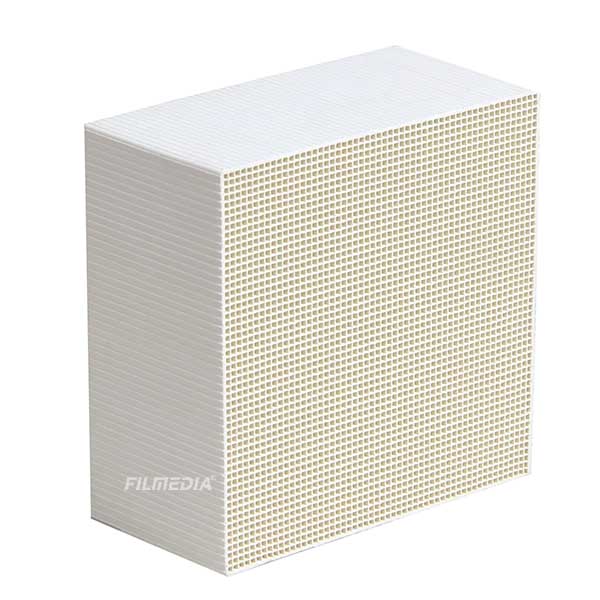
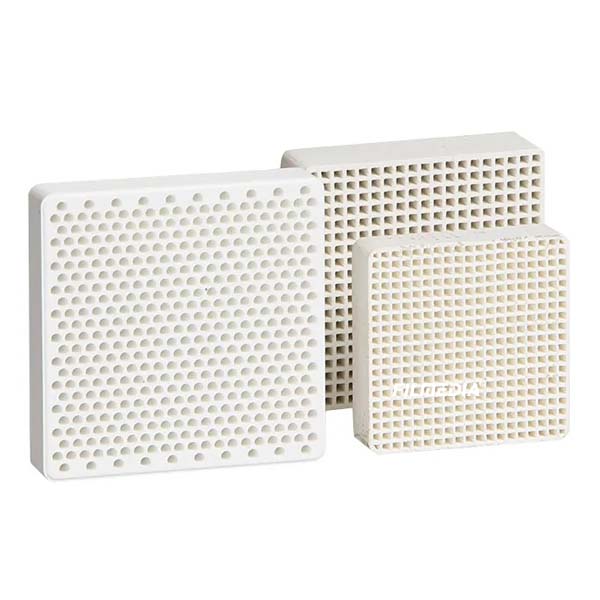
SCR technology is a reaction at use of the denitration catalyst at a certain temperature (270-400ºC), that NOX in the flue gas mixed with NH3 from the reducing agent supply system after the occurrence of the selective catalytic reduction reaction of nitrogen and water, thereby reducing NOx emissions,and reducing smoke pollution to the environment. SCR denitrification catalyst applied in the denitrification process of industrial exhaust pollutant treatment system can promote the selective chemical reaction between reducing agent and nitrogen oxides in flue gas at a certain temperature. The most commonly used SCR catalyst is V2O5-WO3(MoO3)/TiO2 series, which is made into finished products through mixing, extrusion, drying, calcination and other links.
Description
Brief Introduction
- Honeycomb shapes available: 13, 16, 18, 20, 22, and 25 cells.
- Cross-sectional dimensions: 150*150mm or custom sizes, adjustable length.
- Main components: TiO2, V2O5, and WO3.
- Storage requirements: Humidity below 30%, protected from rain, snow, wind, sand, and dust.
Features
- Axial/radial compressive strengths up to 2.5/0.8 MPa, with a specific surface area up to 60 m2/g.
- Primarily used for denitrification of boiler flue gas after dust removal, at temperatures between 120-200°C, with NOx concentrations ranging from 0-1500 ppm.
- Overall denitrification efficiency exceeds 90%, NH3 emissions are less than 3 ppm, and SO2/SO3 conversion rates are less than 1%.
Specifications
| Item | Holes | Section Area(mm) | Wall Thickness(mm) | Opening(mm) |
| 1 | 15*15 | 150*150 | 1.35 | 8.45 |
| 2 | 18*18 | 150*150 | 1.1 | 7.1 |
| 3 | 20*20 | 150*150 | 1.15 | 6.25 |
| 4 | 21*21 | 150*150 | 0.95 | 6.1 |
| 5 | 22*22 | 150*150 | 0.9 | 5.8 |
| 6 | 25*25 | 150*150 | 1.0 | 4.9 |
Manufacturing Process
Mixing Process → Curing Process → Filtration Pre-extrusion →Extrusion Process → Primary Drying → Secondary Drying → Calcination Process → Cutting Process → End Face Hardening → Packaging Process
- Have formatted an mature and stable production process by introducing foreign advanced technology and independent research and development.
- According to practical fuel gas condition,customized design and lectotype available.
- After a number of debugging operation, our comprehensive production lines enable to optimize the core technologies.
- In strict accordance with international standards,Every process is controlled rigidly by Technical Department and Quality Supervision Department.
R&D Technology
- Has imported the United States NOVA 2200e automatic surface area and porosity analyzer, British Malvern MS-2000 laser particle size analyzer, catalyst compression test – electronic universal testing machine, moisture analyzer, Phenom scanning electron microscopy, plastic, catalyst activity evaluation device and other research and development testing equipment.
- Established innovation center and sophisticated R&D team, we currently have 2 external experts with the State Council allowance, 6 senior engineers and 10 researchers with Master Degree.
- Have built solid cooperation with Germany Steinbeis-Transfer Center, Hefei University of Technology, Xi’an Thermal Power Research Institute, Chinese Academy of Sciences, Shanxi Institute of Coal Chemistry and other universities, research institutes.
- By following testing on denitration catalyst’s surface shape, porosity distribution, catalyst activity, running resistance and tracking test of catalyst performance in different fields,We has created catalyst anti-clogging, anti-alkali metal poisoning and other performance enhancement technology.