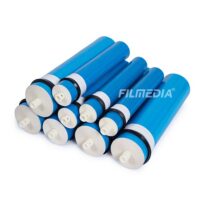
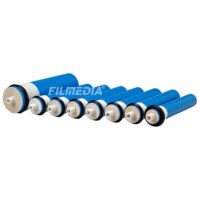
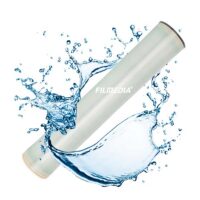
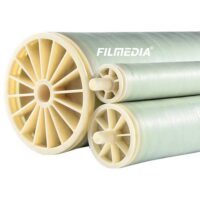
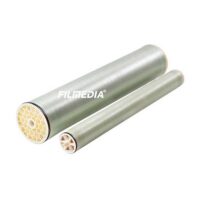
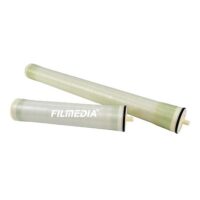
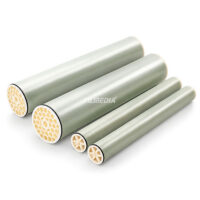
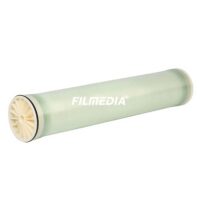
The DTRO (Disk-Tube Reverse Osmosis) membrane is a type of reverse osmosis membrane that combines the features of a reverse osmosis membrane and a hydrofoil. It is designed to be more stable and less prone to clogging, making it a more cost-effective solution for leachate treatment.
Description
The FILMEDIA™ membrane module is the most advanced product in reverse osmosis membrane technology. This membrane module consists of a pressure-resistant housing, circular discs fixed by a central rod, and octagonal membrane sheets arranged between two discs. Each membrane sheet is composed of two filter membranes sealed by ultrasonic welding and separated by a spacer layer.


- The FILMEDIA® DTRO high-pressure reverse osmosis membrane is the core component for separating freshwater from impurities. Made from high-performance polymer materials, aromatic polyamide is selected as the material for the disc-type membrane sheets due to its excellent chemical properties. After initial pressurization by the feed pump and filtration through a safety filter, wastewater enters the high-pressure pump for further pressurization. The recirculation pump provides a high flow rate to meet the velocity requirements on the membrane surface. The liquid flows through the disc-shaped flow channels in a forward/reverse “S” pattern, where small particles, dissolved ions, and other contaminants are retained on the concentrate side. The permeate is collected as purified filtrate.
- The FILMEDIA® DTRO membrane module structure differs significantly from traditional spiral-wound membranes. Its patented open-channel design allows feed liquid to enter the pressure vessel through the inlet, flow between the guide disc and housing to the opposite end, and then pass through 8 channels into the guide disc. The treated liquid rapidly travels across the membrane surface via the shortest path, reverses 180° to the other membrane surface, and flows through the central slot of the guide disc to the next disc. This creates a dual “S” path from the circumference to the center of the disc. Concentrate exits from the feed-side flange. The distance between two guide discs in the FILMEDIA® DTRO module is 3 mm, and the disc surface features specially arranged bumps. This hydraulic design generates turbulence when the liquid collides with the bumps under pressure, enhancing permeation rates and self-cleaning capabilities. It effectively prevents membrane fouling and concentration polarization, extends membrane lifespan, and ensures easy cleaning even under harsh feed conditions.
Structure Diagram
Permeate flows vertically from the outer to the inner side of the membrane and is collected via the central rod. Separation of concentrate and permeate is achieved by sealing rings between the discs and membrane sheets.

| Item | Name | Item | Name | Item | Name | Item | Name | ||||
| 1 | Tie rod | 7 | End flange | 13 | O-ring 14-2 | 19 | Reinforced top flange | ||||
| 2 | Thick nut | 8 | Screwing tie rod | 14 | O-ring 52-4 | 20 | Membrane vessel | ||||
| 3 | Top flange | 9 | Tie rod gasket | 15 | O-ring 48-2 | 21 | Reinforced rod | ||||
| 4 | Distance fitting | 10 | Thin nut | 16 | Membrane cushion | 22 | Reinforced end flange | ||||
| 5 | Hydraulic disc | 11 | Inlet/Outlet connection | 17 | O-ring 39-3 | 23 | Reinforced nut | ||||
| 6 | Lip seal | 12 | Permeate connector | 18 | Screwing tie rod | ||||||
Key Advantages of DTRO for High-Salinity and High-Concentration Wastewater Treatment:
- Stable effluent quality, unaffected by wastewater biodegradability.
- Lower investment and operational costs. Compared to other processes, DTRO achieves high discharge standards with shorter process flows, lower energy consumption, and reduced costs.
- Extended membrane lifespan. The 3 mm open flow channel and unique bump-equipped guide discs minimize scaling, fouling, and concentration polarization.
- Easy cleaning and flux recovery. The special hydraulic design ensures efficient cleaning and prolonged membrane life.
- Simplified maintenance. Standardized design allows easy disassembly, inspection, and replacement of individual components (e.g., membrane sheets). Partial assembly is possible without affecting performance.
- Low replacement costs. Individual components (e.g., membrane sheets) can be replaced separately, unlike spiral-wound or hollow-fiber modules.
FILMEDIA® DTRO Membrane Product Parameters
The specifications and models of FILMEDIA® DTRO series membrane modules are detailed in the following table:
| Model | Membrane Area (m²) | Feed Channel (mm) | Feed Flow (L/h) | Permeate Flow (L/h) | Stable Salt Rejection (%) |
| DTRO-75 | 9.4 | 2 | 700–1300 | 100–130 | 98.50 |
| DTRO-95 | 9.4 | 2 | 700–1300 | 70–120 | 98.50 |
| DTRO-120 | 9.4 | 2 | 700–1300 | 50–80 | 98.50 |
| Note: For nanofiltration membranes and other models, contact our sales team | |||||
DTRO vs. STRO vs. SWRO
| Feature | DTRO | STRO | HRRO/SWRO |
| Structure | Disc-type | Special spiral | Conventional spiral |
| Rejectecd Water Channel (mm) | 2 | 0.8–1.2 | 0.4–0.8 |
| Area (m²) | 9.4 | 27 | 40 |
| Flow Path (mm) | 70 | 1000 | 1400 |
| Spacer Shape | Open | Trapezoidal | Diamond |
| Fouling Resistance | High | Medium | Low |
| Cleaning Cycle | Easy recovery | Easy recovery | Frequent, difficult |
| Pretreatment | Low | Moderate | High |
| Pressure (MPa) | 7.5/9.0/12/16 | 2.0–16.0 | 1.5/4.0 |
| Feed COD | High | Medium | Low |
| Recovery Rate | High | High | Low |
| Maintenance Cost | Low (replaceable) | Moderate | High |
FILMEDIA® DTRO Membrane Applications and Case Studies
The open-channel design and independent membrane module structure of FILMEDIA® DTRO provide superior anti-fouling performance compared to traditional RO membranes. DTRO is particularly suitable for the final stage of zero-liquid discharge (ZLD) systems, effectively treating high CODcr wastewater that conventional membranes struggle with. From a cost perspective, using FILMEDIA® DTRO for concentration reduces the volume of brine entering evaporation-crystallization units, thereby lowering energy consumption and equipment size.
FILMEDIA® DTRO Membrane Primary Applications:
- Treatment of highly polluted wastewater (landfill leachate, electroplating, pharmaceuticals, chemicals, textiles).
- Wastewater treatment projects for “zero discharge” and “near-zero discharge” in industries such as steel, papermaking, dyeing and printing, and coking.
- The original traditional reverse osmosis treatment system concentrated liquid volume reduction wastewater treatment project.