
What is “paste bag”?
“Paste Bag”: Common Disease of Dust Removal Bag——One of the failure analysis of dust removal bag
Aiming at the phenomenon of “paste bag” that often occurs in the operation of dust removal bags, starting from the condition of smoke, dust collector, filter material, operation control and other related factors, we will try to find out the real reason of “paste bag”. Seek ways to avoid “paste bags.”
When the bag is operated in the dust collector, the filter performance is often lost or partially lost for one reason or another, and the actual service life of the bag is greatly shortened as expected, so that the maintenance and operation cost of the factory is greatly increased. “Paste bag” is one of the most typical problems.
“Paste bag” is a phenomenon and a problem in the use of dust removal bag, which is one of the reasons that cause the dust removal bag to lose its effectiveness.
“Paste bag” is in the process of long-term operation or shutdown of dust removal bags, in the working condition where the humidity is high or the oily substance is in contact with the filter material, the dust condenses, adheres or crusts inside the filter surface of the dust removal bag or the filter material and cannot be effectively removed by the online cleaning system, resulting in a significant increase in running resistance.
After the bag is pasted, the dust is densely covered on the surface of the filter bag, so that the effective filtration area of the filter material is greatly reduced, the air permeability of the filter material is drastically decreased, the running resistance becomes high, and the load of the induced draft fan is increased to cause an increase in energy consumption. Seriously, even the induced draft fan can be overwhelmed and unable to operate.
At the same time, the pressure drop of the dust bag is high, so that the online cleaning system is frequently cleaned, which not only consumes a large amount of compressed air, but also cause serious loss of mechanical strength of the filter material, and the service life is greatly shortened. Therefore, if the dust removal bag is always running in the state of paste bag operation, the owner will have to pay higher operating costs for the operation of the system. If the problem of the bag is not solved in time, the owner will have to replace the bag in batches.
In actual working conditions, the factors that may cause the paste bag are more complicated. For specific cases, we must start with the analysis of working conditions smoke, dust collector, operation control and other related factors, in order to understand the true inducing factors of the paste bag, so that the problem can be avoided and solved.
Condensation paste bag
Under normal circumstances, the operating temperature requirement of the bag filter must be higher than the acid dew point temperature of more than 25K. It is safer for the bag. This is mainly to avoid the occurrence of condensation. When the operating temperature is lower than the dew point, the liquid will be formed. Water. Liquid water mixed with dust and gathered on the surface of the filter bag will form a paste bag.
Dew point calculation formula:
ts = 186 + 20lgψH2O + 26lgψSO3
ts : the dew point temperature
ψH2O : the volume fraction of H2O
ψSO3 : the volume fraction of SO3
It can be seen that the higher the moisture content and sulfur trioxide content in the flue gas, the higher the dew point temperature. This means that the continuous operating temperature of the precipitator must be higher. Due to the physical properties and economical operation limitations of the dust removal bag material, the continuous operating temperature of the precipitator must be controlled within a suitable range. If the two are not coordinated, condensation will be inevitable. Therefore, water content, SO3 content and operating temperature are the three main factors determining whether or not condensation occurs.
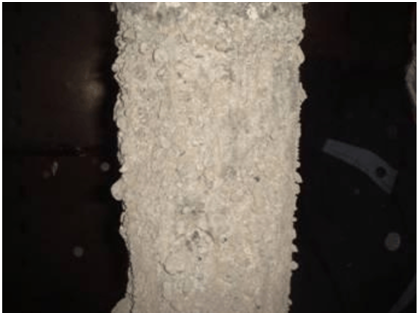
The picture above shows a photo of the paste bag caused by acid condensation in the filter bag of an industrial waste incineration dust collector. The operating temperature of the dust collector is stable at around 150 °C, but the water and sulfide content in the flue gas varies greatly (water content even exceeds 25%) because the main incineration treatment is waste from chemical companies such as solids, liquids and gases with complex composition, and the dew point temperature fluctuates greatly. Condensation is inevitable and the bag is extremely serious. At the same time, due to the penetration of acidic substances and long-term operation, dust gradually crusts on the surface of the filter bag, resulting in loss of air permeability of the filter bag.
The compressed air temperature is generally much lower than the operating temperature of the precipitator. At the moment of the pulse, the low temperature compressed air reduces the temperature of the upper part of the filter bag and decreases rapidly. When the temperature is lower than the dew point, the outer surface of the filter bag at the part will be knotted. Downstream of the compressed air, the effect on the temperature of the air inside the bag is getting smaller and smaller. Therefore, the paste bag phenomenon within one meter below the general dust bag upper is serious.
Furthermore, the air leakage rate of the precipitator is also a possible cause of condensation. The air leakage rate of the general dust collector is about 1-2%. However, the run-off time will increase and the air leakage rate will increase. If it is in the cold winter, the problem becomes more and more tense. The air leakage rate increases, and the local temperature of the dust collector affects the scale. The risk of the bag in the local position is higher and higher due to condensation.
In addition, although the wall of the precipitator is provided with a thermal insulation layer, since the four walls are the forefront of contact with the outside, the temperature is definitely lower than other parts. In actual situation, we find the degree of the bag of the outer ring dust bag which is usually close to the four walls become earlier than somewhere else.
Adhesive paste bag
Mainly because the dust adhesion is relatively large, although no condensation occurs, the dust still adheres to the surface of the fiber, and the online cleaning system cannot remove it. The reasons for the adhesive paste bag may come from the following situations.
① The dust itself has a relatively high viscosity, and when it comes into touching with the filter fiber, the intermolecular force is relatively strong. For example, oily particles, ammonium sulfate formed by denitration, and limestone used for desulfurization.
② Although some dust is not sticky, it is easily deliquescent. When it is trapped on the surface of the fiber, it absorbs moisture from the air and forms a solution on the surface of the fiber. For example, powdered sugar.
③ Some dust adhesion may not be strong, but it can absorb the moisture in the flue gas and carry out the chemical process of recrystallization to generate new hydraulic substances or crystals, and the formed “crust” covers the surface of the filter. For example: cement clinker, the product of desulfurization —— calcium sulfate.
④ Even if the dust itself is not sticky, if the dust particles are fine and the water content of the dust is relatively large, the dust is easily adsorbed evenly on the surface of the filter material to form a layer of “floating ash”, and the adhesion is not very strong, but very hard to remove. The longer the running time, the thicker the “floating ash”. This may happen in general coal-fired power plants, especially for filter bags longer than 6 meters. For some reason, a northern power plant has caused the running resistance of the precipitator to rise to 2200Pa in a short period of time from around 1500Pa, causing serious downtime of the entire line.
Structural paste bag
We classify all paste bags that are caused by improper design and structure of the dust collector and structural parts into structural paste bags.
Filter material structure and treatment
Some filter materials have loose needle-density fibers, and the filter surface fibers are loose. Even if the surface is singulated, fine dust can easily enter the filter material and reside therein. The dust accumulates to a certain extent inside, and the influence of water vapor in the flue gas gradually forms a blockage from the inside out.
In addition, some filter media have no or no singeing or calendering treatment, and the fiber ends retain the fiber ends, which actually provides “condensation nodules” for condensation, so that condensation begins first from the fiber ends. Dust will also form dust clusters at this position first. As the dust clusters become larger and larger, they will bridge each other, and a large area of paste bags will gradually form. In waste incineration power plants that use pure PTFE filter media, if there is no other treatment on the surface, stubborn dust crusts at the end of the fiber can often be found.
In addition, for working conditions with high humidity or risk of acid condensation, the filter material is not treated hydrophobically, and paste bags are more common.
Filter bag fit
We know that pulse cleaning is actually the impact of the pulsed airflow and the secondary airflow on the filter bag, so that the filter bag deforms from the top to the bottom in the latitudinal direction, the inertia of the deformation and the collision of the filter bag with the cage bone on the surface dust layer. Causes an “avalanche effect” that removes surface dust. The cleaning effect depends largely on the magnitude of the deformation inertia and the strength of the collision between the filter bag and the filter cage . In practical applications, due to the small size of the filter bag latitude or the degree of heat shrinkage of the filter material in use, the filter bag “bundled” cannot be separated on the filter cage after a period of use. At this time, the shape of the filter bag caused by pulse cleaning is small, the collision intensity between the filter bag and the filter cage is limited, and the surface dust cannot be effectively removed. Dust accumulation on the surface of the filter bag and long-term accumulation may cause a paste bag.
Pressure distribution in the blow pipe
At present, a large number of dust collectors are sprayed and cleaned. Each line consists of a blowpipe that is responsible for the cleaning of more than a dozen bags of the line. A small number of small injection holes or blowing pipes of the same size are uniformly distributed on the blowing pipe, and one small blowing hole or the blowing pipe corresponds to one bag. Theoretically speaking, when the compressed air advances in the blowing pipe, the gas dynamic pressure is gradually converted into static pressure, and such conversion directly causes the amount of compressed air obtained in each filter bag of the row to be different. The cleaning effect is different. The risk of poor paste cleaning is relatively high. At the scene, we also selected several filter bags of the same row in the same state to compare the air permeability. The difference between the highest and the lowest is relatively large. Indirectly explain the objective existence of this situation.
Insufficient injection pressure
Generally, the cleaning pressure at the site can be adjusted. If the cleaning pressure is not too good, the cleaning effect is not good, and dust accumulates on the surface of the filter bag. In the long run, the risk of the paste bag is relatively high. If this happens, there are two possibilities: one is the system design limitation, that is, the maximum pressure that the system can provide is too small; the other is that the blowing interval is too short, and the system pressure has not recovered after the first injection. At the required pressure, a second pulse is started.
Operation error
① Pre-spraying as required, so that the oil mist in the ignition directly invades the filter material, causing the paste bag.
② When the switch is turned on (especially before a long shutdown), the machine is not turned on and off in the correct way.
③When the boiler has an accident such as a pipe burst during operation, the filter bag is not properly handled and remedied.