
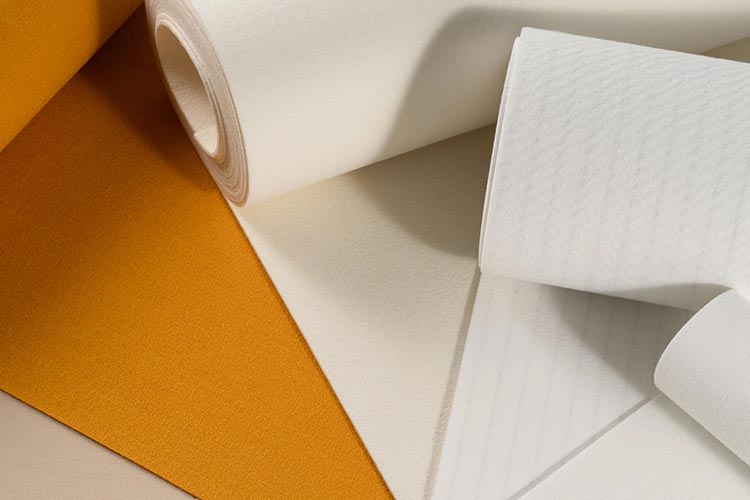
Fiberglass needle felt is a high-performance, high-temperature filtration and insulation material manufactured from glass fiber through a needle-punching process. It features a three-dimensional porous structure with high void content, ensuring low filtration resistance, high permeability, and excellent dust collection efficiency of up to 99.9%.
Thanks to its open fiber structure, fiberglass needle felt offers a filtration speed approximately twice that of traditional woven fabric filters, making it highly suitable for demanding industrial environments.
This material is widely used in high-temperature flue gas filtration applications such as carbon black production, chemical processing, steel and metallurgy industries, coal-fired boilers, cement plants, and refractory material production.
It is also well-suited for high-speed pulse-jet cleaning filter bags, maintaining stable performance under long-term exposure to high temperatures and corrosive media. Fiberglass needle felt effectively controls dust emissions while enabling the recovery of valuable fine particles, supporting environmental protection and resource recycling.

Key Features and Advantages
- Excellent thermal insulation performance
According to physical principles, gases have very low thermal conductivity. Effective insulation materials therefore require a large number of internal air pockets. Fiberglass needle felt contains numerous micro air cavities and randomly arranged fibers, making it an outstanding thermal insulation material.
Thermal conductivity: approximately 0.20–0.40 kcal/m·h·°C. - Non-combustible and high temperature resistance
The main component of fiberglass is silicate (over 50%), giving it non-flammable properties, no deformation or embrittlement, and a continuous operating temperature of up to 700°C. - Excellent sound absorption
When sound waves penetrate fiberglass needle felt, energy is dissipated through friction between fibers of different diameters and cavitation within the porous structure. As a result, the sound absorption rate can exceed 90%, effectively reducing noise pollution. - Superior electrical and thermal insulation
Fiberglass exhibits high temperature resistance, good mechanical strength, and excellent chemical stability. It is widely recognized as one of the best insulation materials for industrial use. - High chemical and corrosion resistance
Fiberglass needle felt is resistant to acids, alkalis, and most chemical agents. Long-term exposure does not significantly degrade its functional performance. - Excellent elastic recovery and mechanical strength
The material contains a large number of fixed micro-cavities, providing outstanding resilience, resistance to shock and vibration, and a tensile strength of 1.0 kg or higher. - Very low moisture absorption
The moisture absorption rate is close to zero, ensuring stable performance even in humid environments. - Lightweight and flexible
Compared with other soft insulation materials, fiberglass needle felt is lighter and more flexible, reducing structural load and vibration when installed on equipment. - Easy processing and installation
The material can be customized to any size or shape according to customer requirements and allows simple cutting, wrapping, and installation.
Main Applications
- Thermal insulation for high-temperature equipment using coal, electricity, oil, or gas.
- Insulation and fireproof materials for industrial and commercial use.
- Sealing, sound absorption, filtration, and insulation in special environments.
- Thermal insulation for heat exchangers and heat storage equipment.
- Sound and thermal insulation for automobiles, ships, and aircraft components.
- Muffler cores and engine noise silencers for automobiles and motorcycles.
- Insulation layers in color steel structures and wooden buildings.
- Thermal and chemical pipeline insulation, offering better performance than conventional materials.
- Insulation linings for air conditioners, refrigerators, microwave ovens, dishwashers, and other household appliances.
- Any application requiring thermal insulation, fire resistance, sound absorption, and noise reduction.