

In the limestone processing industry, dust is generated throughout the entire process from raw material mining to finished product packaging. As a core component of dust control, dust filter bags are not only related to production compliance and environmental safety but also directly affect an enterprise’s resource utilization efficiency and employees’ occupational health. This article systematically expounds on their importance and working principles, and focuses on analyzing the characteristics of two mainstream types of filter bags, providing references for filter bag selection in limestone plants.
Dust collection filter bags play a crucial role in limestone production
Limestone, a key raw material for chemical products like calcium carbonate, cement, and metallurgical flux, undergoes multiple processing steps, including transportation, drying, crushing, screening, grinding, and packaging. Due to material collisions and airflow disturbances, each process generates a large amount of dust (primarily calcium carbonate, with particle sizes ranging from 0.1 to 10 microns). Failure to effectively collect this dust can lead to numerous problems:
☑ Environmental
Uncollected dust can be carried by wind, causing excessive concentrations of particulate matter (PM10/PM2.5) in the air around the plant and surrounding areas, violating air pollutant emission standards and resulting in environmental penalties. Furthermore, dust deposition can pollute soil and water, harming the ecological environment.
☑ Occupational health
Long-term inhalation of limestone dust can cause pneumoconiosis (an irreversible pulmonary fibrosis) in workers. Furthermore, dust can irritate the respiratory tract and eyes, increasing the risk of respiratory infections and endangering employee health.
☑ In terms of resources and costs
Limestone dust is a recyclable raw material, and failure to collect it results in material waste (statistics show that the dust loss rate during limestone processing can reach 3%-8%). Furthermore, dust adheres to equipment surfaces, accelerating wear and tear, clogging pipes and valves, and increasing maintenance costs and downtime.
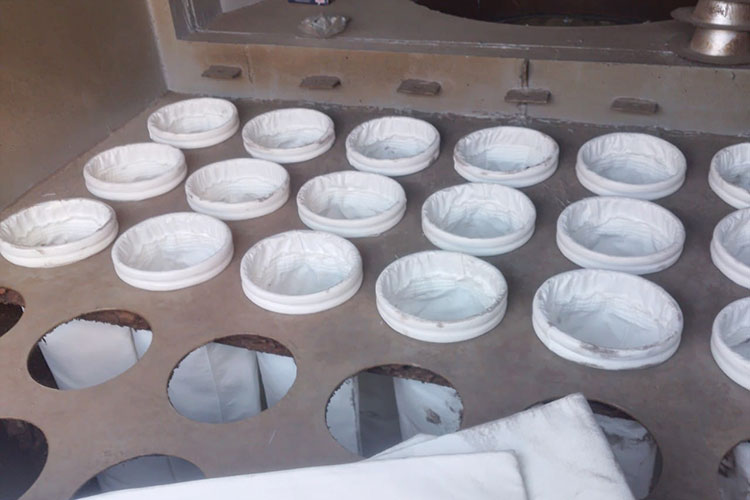
Working Principle of Filter Bags for Collecting Limestone Dust
The commonly used dust collection equipment in limestone plants is the baghouse dust collector, and the filter bag is the “core filtering unit” of this equipment. The process of collecting dust relies on multiple filtering mechanisms, with the specific principles as follows:
- Inertial Impaction and Interception
When the dust-laden gas flows through the filter bag, the direction of the gas flow changes due to the obstruction of the filter cloth fibers. However, dust particles with larger sizes (usually >1 micron) cannot turn with the gas flow due to inertial force, directly colliding with the fibers and being intercepted on the surface of the filter cloth.
- Brownian Motion Capture
For fine dust particles with sizes <1 micron, their movement is affected by the impact of gas molecules (i.e., Brownian motion), resulting in an irregular movement trajectory. Eventually, they come into contact with the filter cloth fibers and are adsorbed.
- Sieving Effect
As the filtering process progresses, a “primary dust layer” is gradually formed on the surface of the filter cloth. The pores of this primary layer are smaller, which can act like a “sieve” to further intercept dust in the subsequent gas flow, significantly improving the filtering efficiency (after the formation of the primary dust layer, the filtering efficiency can increase from the initial 95% to over 99.9%).
- Electrostatic Adsorption Assistance
Some filter cloths (such as needle-punched felt treated with electrostatic technology) themselves carry static charges, which can adsorb charged dust (limestone dust is prone to static electricity during friction and collision) through electrostatic attraction, further enhancing the collection effect.
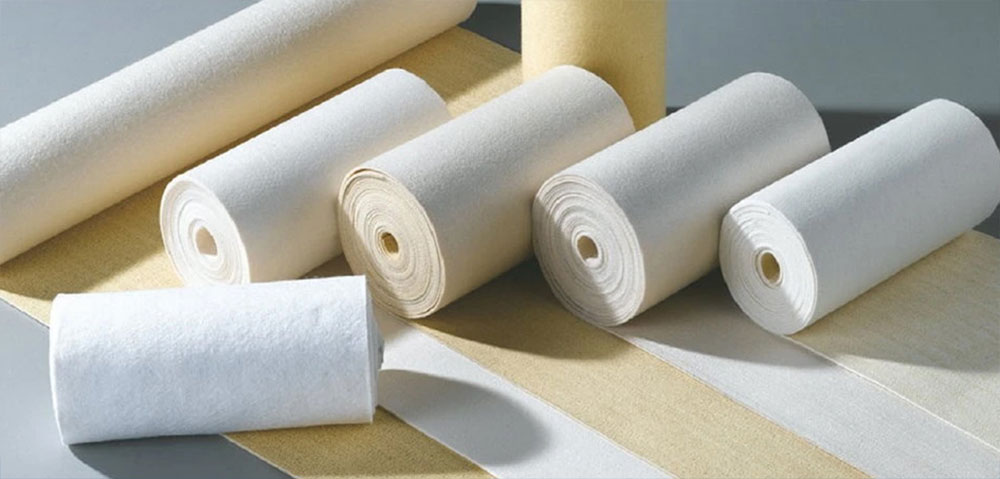
Suitable Types and Characteristics of Filter Bags for Limestone Factory
It should be noted that the performance of the filter cloth directly determines the filtering efficiency and service life. High-quality filter cloths need to have appropriate density (ensuring air permeability while preventing dust penetration), good heat resistance (to adapt to high-temperature gas flows in limestone drying and calcination processes, usually with temperatures ranging from 80℃ to 180℃), certain corrosion resistance (to cope with trace acidic gases that may exist in limestone processing), and high mechanical strength (to resist air flow impact and wear during dust cleaning).
Considering the characteristics of limestone dust (no strong corrosiveness, no strong viscosity, and temperatures mostly in the medium-low range), the core requirements of limestone plants for filter bags are “high dust holding capacity, high filtering efficiency, long service life, and low cost”. Among them, needle-punched felt filter bags have become the first choice for limestone plants due to their characteristics of “large porosity, good air permeability, and wear resistance”.
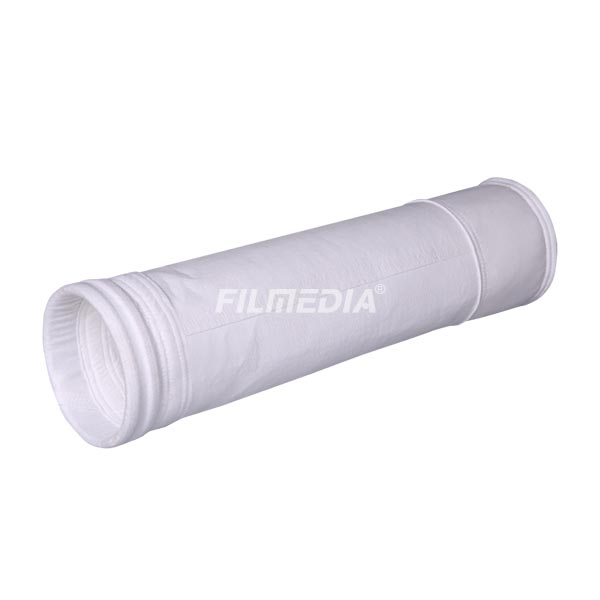
Polyester Needle-Punched Felt Filter Bags
Polyester (chemically known as polyethylene terephthalate) is one of the most widely used filter materials in limestone plants. The needle-punched felt filter bags made from it can meet the needs of most limestone processing scenarios, with the following core characteristics:
| Characteristic Dimension | Specific Performance |
|---|---|
| Temperature Resistance | The normal operating temperature range is 120℃-150℃, and the instantaneous temperature resistance can reach 180℃, which is suitable for medium-low temperature processes in limestone processing (such as drying and crushing, where the gas flow temperature is mostly <150℃). |
| Filtering Efficiency | The porosity of polyester needle-punched felt can reach 70%-80%, with an initial filtering efficiency of >95%. After the formation of the primary dust layer, the efficiency exceeds 99.9%, which can effectively collect limestone dust with particle sizes of 0.1-10 microns. |
| Dust Holding Capacity | It has a high dust holding capacity (usually 200-400g/㎡), which can reduce the frequency of dust cleaning (the dust cleaning interval can reach 30-60 minutes), reduce filter bag wear, and extend the service life. |
| Mechanical Performance | It has high tensile strength (warp direction ≥1800N/5cm, weft direction ≥1500N/5cm) and good wear resistance (the damage rate is <5% after 100,000 friction tests), which can resist air flow impact and mechanical force during pulse dust cleaning. |
| Corrosion Resistance | It has good resistance to neutral and weakly alkaline gases (such as carbon dioxide and trace calcium hydroxide dust in limestone processing), but is not resistant to strong acids (such as hydrochloric acid and sulfuric acid) and should not be used in acidic working conditions. |
| Cost-Effectiveness | The cost of polyester raw materials is low, the processing technology is mature, and the unit price is only 1/3-1/2 of that of aramid filter bags. Moreover, the service life can reach 1-2 years (under normal working conditions), resulting in extremely high overall cost-effectiveness. |
| Applicable Scenarios | Medium-low temperature working conditions without acidic gases in limestone processing, such as crushing, screening, packaging, and raw material transportation. It is the “basic preferred filter bag” for limestone plants. |

Aramid Needle-Punched Felt Filter Bags
Aramid (chemically known as aromatic polyamide) is a high-performance synthetic fiber. The filter bags made from it are suitable for high-temperature working conditions in limestone plants (such as tail gas treatment after lime kiln calcination, with temperatures up to 180℃-220℃), with the following core characteristics:
| Characteristic Dimension | Specific Performance |
|---|---|
| Temperature Resistance | The normal operating temperature range is 180℃-200℃, and the instantaneous temperature resistance can reach 220℃-240℃. It is suitable for high-temperature processes such as limestone calcination and high-temperature drying, solving the problem that polyester filter bags are prone to softening and shrinkage at high temperatures. |
| Filtering Efficiency | Aramid needle-punched felt also adopts a three-dimensional structure, with a porosity of approximately 65%-75%. Its filtering efficiency is equivalent to that of polyester filter bags (exceeding 99.9% after the formation of the primary dust layer), which can effectively collect fine dust under high-temperature working conditions. |
| Mechanical Performance | It has extremely high mechanical strength (tensile strength: warp direction ≥2000N/5cm, weft direction ≥1800N/5cm). Its wear resistance and tear resistance are better than those of polyester filter bags. Under working conditions with high-frequency dust cleaning or high air flow velocity (such as lime kiln tail gas treatment, with an air flow velocity of 1.2-1.5m/min), it has a longer service life. |
| Corrosion Resistance | Its acid and alkali resistance is better than that of polyester filter bags: it has good resistance to weakly acidic gases (such as a small amount of sulfur dioxide that may be generated during the calcination process) and complete resistance to alkaline gases (such as calcium hydroxide dust), resulting in a wider application range. |
| Service Life | Under high-temperature working conditions, its service life can reach 2-3 years (1.5-2 times that of polyester filter bags under high-temperature working conditions), which can reduce the frequency of filter bag replacement and lower downtime maintenance costs. |
| Limitations | The cost is high (the unit price is 3-5 times that of polyester filter bags), and it is not resistant to high-temperature hydrolysis (if the high-temperature gas flow contains a large amount of water vapor, waterproof treatment should be matched). Its cost-effectiveness is lower than that of polyester filter bags when used in medium-low temperature working conditions. |
| Applicable Scenarios | High-temperature working conditions such as limestone calcination kiln tail gas treatment and high-temperature dryer tail gas filtration, or processing links with trace acidic gases. It is the “special filter bag for high-temperature working conditions” in limestone plants. |