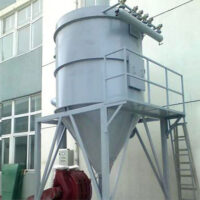
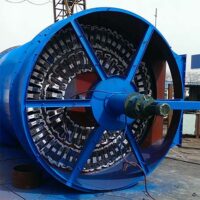
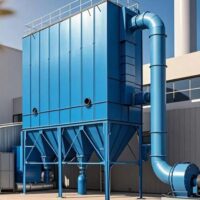
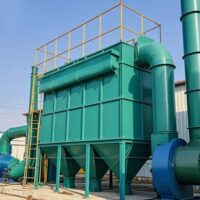
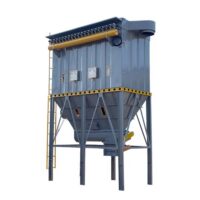
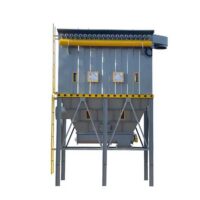
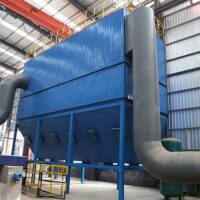
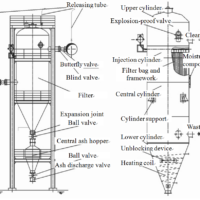
The pulse jet baghouse filter is an air pollution control device used to filter particulate matter from industrial exhaust gases. It works by collecting dust and particulate matter in a filter medium (usually a fabric bag) and then cleaning the filter bag using a high-pressure air flow (pulse jet).
Description
Parameters
| Modle | DMC-24 | DMC-36 | DMC-48 | DMC-64 | DMC-80 | DMC-100 | DMC-120 | |
| Total filter area (m²) | 19.2 | 28.8 | 38.4 | 51.2 | 64 | 80 | 96 | |
| Filtration wind speed (m/min) | 1.00-2.00 | 1.00-2.00 | 1.00-2.00 | 1.00-2.00 | 1.00-2.00 | 1.00-2.00 | 1.00-2.00 | |
| Air volume handled (m³/h) | 1152-2304 | 1728-3456 | 2304-4608 | 3072-6144 | 3840-7680 | 4800-9600 | 5760-11520 | |
| Filter bag quantity (PCS) | 24 | 36 | 48 | 64 | 80 | 100 | 120 | |
| Filter bag size(mm) | Φ133×2000 | Φ133×2000 | Φ133×2000 | Φ133×2000 | Φ133×2000 | Φ133×2000 | Φ133×2000 | |
| Gas consumption (m³/min) | 0.204 | 0.204 | 0.204 | 0.204 | 0.204 | 0.204 | 0.204 | |
| Inlet concentration (g/Nm³) | 100 | |||||||
| Outlet concentration (mg/Nm³) | 50 | |||||||
| Blowing pressure (MPa) | 0.3-0.4 | |||||||
| Withstand pressure (Pa) | ±5000 | |||||||
| Equipment resistance (Pa) | 1200~1700 | |||||||
| Dust removal efficiency(%) | >99% | |||||||
| Pulse valve | Specification | 1″ | ||||||
| Amount | 4 | 6 | 6 | 8 | 10 | 10 | 12 | |
| Motor power(kw) | 2.2 | 3 | 4 | 5.5 | 7.5 | 11 | 15 | |
| Gr.wt(Kg) | DMC(A) | 600 | 900 | 1200 | 1600 | 2000 | 2500 | 3000 |
| DMC(B) | 480 | 720 | 960 | 1280 | 1600 | 2000 | 2400 | |
Pulse Jet Baghouse Dust Collector – In-depth Technical Principle Analysis
As a core piece of equipment in high-efficiency dust control systems, the pulse jet baghouse dust collector integrates multiple disciplines including fluid mechanics, filtration and separation, pneumatic control, and automated monitoring.
Its primary goal is to achieve continuous, efficient, and low-resistance purification of dust-laden gas at high concentrations.
This article provides a systematic analysis of its working principle from four aspects:
(1) gas–solid separation process,
(2) intelligent pulse cleaning mechanism,
(3) compartmental offline cleaning advantages, and
(4) key parameter control.
1. Gas–Solid Separation Process
When the dust-laden gas enters the hopper through the inlet, the sudden expansion of the flow path causes an expansion effect.
According to the law of conservation of momentum, large dust particles (d₅₀ > 20 μm) are separated first by inertial collision and gravitational settling, falling into the hopper for primary pre-filtration.
The air, evenly distributed by the flow guide device, then enters the filtration chamber.
Dust particles are captured on the outer surface of the filter bags through inertial diffusion, interception, and Brownian motion.
A dense dust cake gradually forms on the bag surface, serving as a dynamic filtration medium.
The purified gas passes through the filter material pores into the clean air chamber, and is then discharged via the valve plate openings and exhaust duct, achieving efficient gas–solid separation.
This process embodies the deep filtration mechanism: the composite interface formed by the filter fibers and dust cake enhances filtration efficiency over time instead of degrading it.
2. Intelligent Pulse Cleaning Mechanism
As filtration continues, the dust layer on the bag surface thickens and system resistance rises linearly.
When the differential pressure sensor detects that resistance reaches the preset threshold (typically 1200–1500 Pa), the PLC-controlled system automatically activates the staged cleaning program as follows:
1️⃣ Airflow Cut-off Phase
The pneumatic lift valve of the target compartment closes, forming a sealed environment to prevent secondary dust emission during cleaning.
2️⃣ Pulse Jet Phase
Compressed air (0.4–0.6 MPa) stored in the air tank is instantaneously released through the pulse valve (opening time 0.1–0.2 s), generating a reverse high-velocity airflow with a peak pressure of about 0.3 MPa.
This jet travels along the blowpipe into the filter bag, creating a shock wave and transient pressure differential that causes the bag to expand and contract rapidly like a balloon.
3️⃣ Dust Detachment Phase
Under inertial and shear forces, the dust cake fractures and detaches from the bag surface, falling into the hopper by gravity.
Tests show that a single pulse cleaning cycle removes 85–90% of the residual dust layer, effectively restoring the bag’s permeability and filtration performance.
3. Advantages of Compartmental Offline Cleaning
The pulse jet baghouse adopts a modular compartment structure, typically consisting of 4–12 independent filtration units.
When one compartment undergoes cleaning, others continue filtration, realizing a synchronous mode of online filtration and offline cleaning.
This design provides three notable advantages in industrial dust collection systems:
-
Efficient Cleaning:
Short, high-pressure pulses completely remove dust layers, improving cleaning efficiency by 3–5 times over conventional reverse-blow systems. -
Low Operating Resistance:
Post-cleaning, the bag resistance recovery rate exceeds 95%, maintaining long-term differential pressure stability at 800–1000 Pa. -
Strong Adaptability:
Capable of handling inlet dust concentrations up to 1000 g/m³, with outlet emission levels below 30 mg/m³, meeting stringent environmental standards.
In industries such as steel, power generation, cement, and chemical processing, pulse jet baghouse dust collectors have become the mainstream solution for particulate emission control.
With the integration of intelligent differential pressure feedback and real-time bag monitoring technologies, their performance and automation levels continue to advance in the field of industrial environmental protection.